content strategy
How to Become a High-Demand SEO Content Writer
SEO content writer insights for 2026. How to excel, common pitfalls, and tools that elevate your writing. Elevate your career today.
Published: 10/15/2026
How to Become a High-Demand SEO Content Writer

You’ve spent hours crafting content, ticking every SEO box, and watched it sink faster than a stone in water (let’s pretend it was a particularly heavy stone). You’ve read every guide, tried every tip, but your articles still lurk in the digital dark, unseen and forgotten. Maybe you feel like one of those SEO ghosts, haunting blogs with great intentions but zero results.
This doesn’t just waste your time; it kills your visibility. And in this world where Google holds the keys to online success, invisible means irrelevant. As an SEO content writer, the stakes have never been higher. The space shifts faster than a toddler's mood, leaving those who can’t adapt stuck on page two-where ranking opportunities go to die.
But here's the good news: by the end of this article, you’ll know exactly how to become a high-demand SEO content writer. You’ll learn which strategies work, which to toss, and the single most effective change you can make to see results in 60 days. We’ll even uncover the tools that will save you from the endless maze of outdated techniques.
Consider this: 90% of content gets zero traffic from Google. Yeah, you read that right. What if you could break into that elusive 10%? Stay with me, and I’ll show you how to turn your writing into a traffic magnet. Ready for the ride?
⚡ Quick Answer
- 🏆 Best overall: Understand SEO fundamentals: essential for crafting content that ranks
- 💸 Best budget: Use free SEO tools: effective for beginners without the cost
- 🚀 Best for career growth: Mastering keyword research: crucial for creating targeted content
Why SEO Content Writing Keeps Failing
Common Misconceptions
SEO content writing isn't about shoving keywords into every sentence. Many writers fall into the trap of keyword stuffing, believing it will boost rankings. It doesn't. Google's smarter than that and knows when you're trying to game the system. Instead, it’s about relevance and intent. Overloading your content with keywords tells Google you don’t know what you’re talking about, which can actually push your site down the rankings. Keyword density alone won't carry the day. Recognize the difference between mindful keyword usage and spammy repetition.
The Anti-Stuffing Principle Fewer keywords can be more. Focus on natural language and user intent rather than cramming phrases in.
Overlooked SEO Basics
Many writers ignore fundamental SEO basics, such as using meta tags correctly or optimizing images. These elements are crucial for search engines to understand your content. Google Search Console is your ally here, offering insights on where your content falls short. Miss these basics, and you're building a house without a foundation. Jumping straight into content creation without setting these pillars can lead to poor visibility and wasted efforts.
Where Writers Go Wrong
Execution often falters not in the writing but in the planning. Writers focus on flashy trends rather than solid content strategy. This leads to articles that are unaligned with actual user searches. Also, relying solely on SEO tools without understanding their data can mislead strategies. A tool might suggest a keyword with high search volume, but without considering search intent, the content won't resonate with readers or algorithms.
Ignoring these pitfalls makes mastering the mechanics of SEO more critical. To truly excel, content creators must unite SEO fundamentals with strong writing skills. That's the groundwork for the next step: "Mastering the Mechanics of SEO Content."
Mastering the Mechanics of SEO Content

Most content fails because people ignore the fundamentals. They jump to trends without mastering keyword research, structure, and the right tools.
| Factor | What It Measures | Why It Matters | How to Evaluate It | Weight/Priority |
|---|---|---|---|---|
| Keyword Relevance | Alignment with target audience | Ensures content reaches the right users | Analyze search intent using Ahrefs or SEMrush | High |
| Search Volume | Potential traffic size | Guides prioritization of keywords | Check Google Keyword Planner | Medium |
| Content Structure | Organization for readability | Improves user engagement and SEO performance | Use headings and subheadings strategically | High |
| Tool use | Effective use of SEO tools | Enhances analysis and strategy formulation | use insights from Ahrefs and SEMrush | Medium |
| Competitor Analysis | Benchmark against industry standards | Identifies gaps and opportunities | Monitor competitors' strategies | High |
Keyword Research
Jumping into content creation without solid keyword research is like setting sail without a compass. Effective keyword research targets the audience you want, not the one you assume you have. Use tools like Ahrefs and SEMrush to find keywords with high relevance and feasible difficulty. But don’t trust keyword difficulty scores blindly; they can mislead. Check the search engine results page (SERP) to validate how your content will really perform against competitors.
Don't Get Blinded by Volume High search volume isn't everything. Always assess user intent and competition on the SERPs.
Content Structure
A killer article isn’t just about the words; it's how you arrange them. A well-structured piece holds readers' attention and aids SEO. Use clear headings, subheadings, and bullet points to make content digestible. This boosts engagement, which search engines love. SEO copywriting isn't just about keywords; it's about presenting information in a way that speaks to both humans and algorithms. Remember, if it’s not easy to read, it won’t engage your audience.
SEO Tools
Tools like Google Keyword Planner and Ahrefs should be in your arsenal. They offer crucial insights that can refine your content strategy and pinpoint areas requiring content optimization. But beware, tools are just that-tools. Insight doesn’t equal execution. You need to act on what these tools reveal. It’s common for people to pay for subscriptions and never use the data. That’s money down the drain.
Mastering the mechanics of SEO is a dance between research, structure, and the strategic use of tools. Once you've got these mechanics down, it's time to move on to what really affects your success: "The Metrics That Matter in SEO Content Writing."
The Metrics That Matter in SEO Content Writing
Traffic without engagement is like a concert with empty seats. It might look impressive, but it's not moving anyone. You need to know which metrics matter and why. Here's what to evaluate:
| Factor | What It Measures | Why It Matters | How to Evaluate It | Weight/Priority |
|---|---|---|---|---|
| Organic Traffic | Visitors from search engines | More visitors can lead to more leads or sales | Check Google Analytics traffic sources | High |
| Engagement | User interaction with content | Signals content quality and relevance | Review time on page and session duration | High |
| Conversion Rates | Percentage of visitors taking action | Directly tied to revenue | Track goals in Google Analytics | High |
| Bounce Rate | Single-page sessions | High rates often mean content mismatch | Analyze bounce rate in Google Analytics | Medium |
| Keyword Rankings | Position in search results | Higher rankings drive more traffic | Use keyword tracking tools | Medium |
Traffic and Engagement
Most people obsess over traffic numbers, but without engagement, it's pointless. High traffic with low engagement is like owning a flashy car that won't start. Use Google Analytics to measure both. If users spend time on your page, you've done something right. Engagement proves your content strategy works.
Engagement Over Vanity A high page view count means little without genuine user interaction. Measure engagement to gauge content effectiveness.
Conversion Rates
Your content isn't just there to decorate the internet. It needs to drive action. Conversion metrics are your proof of concept. High traffic should translate to clicks, sign-ups, or sales. If it's not happening, revisit your SEO copywriting and content optimization strategies. Focus on action-oriented keywords.
Bounce Rates
If visitors are leaving your site faster than a bad date, you have a problem. High bounce rates usually signal content quality issues or a disconnect between search intent and your offering. Conduct keyword research to align content with user expectations. A YouTube walkthrough from aimforseo shows exactly how to tackle this.
Metrics only tell half the story without tools that help you act on them. Next, it's time to dive into "Tools and Approaches Worth Your Time" to bridge that gap.
Video: How to write content Beyond SEO Keywords? #aiseo ... (YouTube · aimforseo)
Tools and Approaches Worth Your Time

Free vs. Paid Tools
Free tools like Ubersuggest are a solid starting point for beginners. They provide basic keyword insights and SEO audits without the financial commitment. However, once you hit a certain level of complexity in your content strategy, you'll find them limiting. You can't ignore what paid tools bring to the table. Moz, for example, offers in-depth analytics and advanced keyword research capabilities, but it comes at a cost-a barrier for those with tight budgets. Finding the right balance between free and paid options will depend on where you are in your SEO process.
Tool Comparisons
Choosing the right tool can make or break your SEO copywriting efforts. Yoast SEO is often the go-to for WordPress users, offering content optimization right in your CMS. Meanwhile, Moz provides comprehensive analytics and a suite of diagnostic tools like keyword explorer and link explorer, critical for more strong content strategies. Ubersuggest, though less powerful, still gives you important insights without the cost. Understand that while free tools offer accessibility, paid tools like Moz provide the sophistication needed for scaling efforts.
Best Practices
Arming yourself with the right tools isn't enough-you need to know how to wield them effectively. Start with keyword research, but don't stop there. Use analytics tools to measure the impact of your SEO efforts and adjust your content strategy accordingly. Remember, SEO trends change and your approach needs to be flexible. One major pitfall is relying too heavily on any single tool; diversification remains key. Discover the best practices by examining expert opinions and reviews to keep your strategy fresh.
Don't Overlook Versatility Using multiple tools offers a more comprehensive view of your SEO space. Ubersuggest for initial insights, Yoast for optimization, and Moz for deep dives-this combination caters to every stage of SEO maturity.
Here's how they stack up:
| Option | Key Difference | Best Use Case | Main Limitation | Price |
|---|---|---|---|---|
| Ubersuggest | Basic keyword insights | Beginners | Limited advanced features | Free |
| Moz | Comprehensive analytics | Advanced SEO teams | High cost | $99/mo |
| Yoast SEO | CMS integration | WordPress users | Platform dependent | Free - $99/yr |
Once you've chosen the right tools, the next challenge is measuring your SEO efforts effectively. That's where our next section comes in: "How to Measure Your SEO Content Success."
How to Measure Your SEO Content Success
Tracking Progress
Your SEO content's success hinges on consistent tracking. Google Search Console is your go-to tool here. It tells you which pages pull in clicks and which keywords drive traffic. Check it weekly. Not monthly. Weekly. Pages rising? Focus. Pages dropping? Find out why. Data from Search Console is like a health chart for your site.
Don't Trust Blind Metrics Bounce rate and time on page can mislead. Match your focus to real user actions. Google Search Console shows which pages actually convert visitors into results.
Adjusting Strategies
SEO isn’t a set-it-and-forget-it game. Strategies need tweaking based on data. SEO copywriting evolves with trends, and what worked yesterday might flop tomorrow. Dig into the metrics. If your SEO tools show a dip, adapt. Maybe you targeted the wrong keyword or missed search intent. Fix it, fast. Remember, being nimble trumps being perfect.
Long-term Goals
Short-term wins feel good. But SEO is a marathon, not a sprint. Set long-term goals. Where do you see your site in six months? A year? Your content strategy should align with these goals. Use keyword research to plan content that builds towards these milestones. Regularly revisiting your digital marketing objectives ensures you stay on course and adjust as SEO trends shift.
Success in SEO content writing isn't about magical tools or one-time wins. It's about relentless tracking, smart adjustments, and aiming for the horizon. Keep your finger on the pulse, and you'll know when to sprint and when to pace. That's how you outlast the competition. Now, go make it happen.
The Missing Link: change Data into Actionable Content
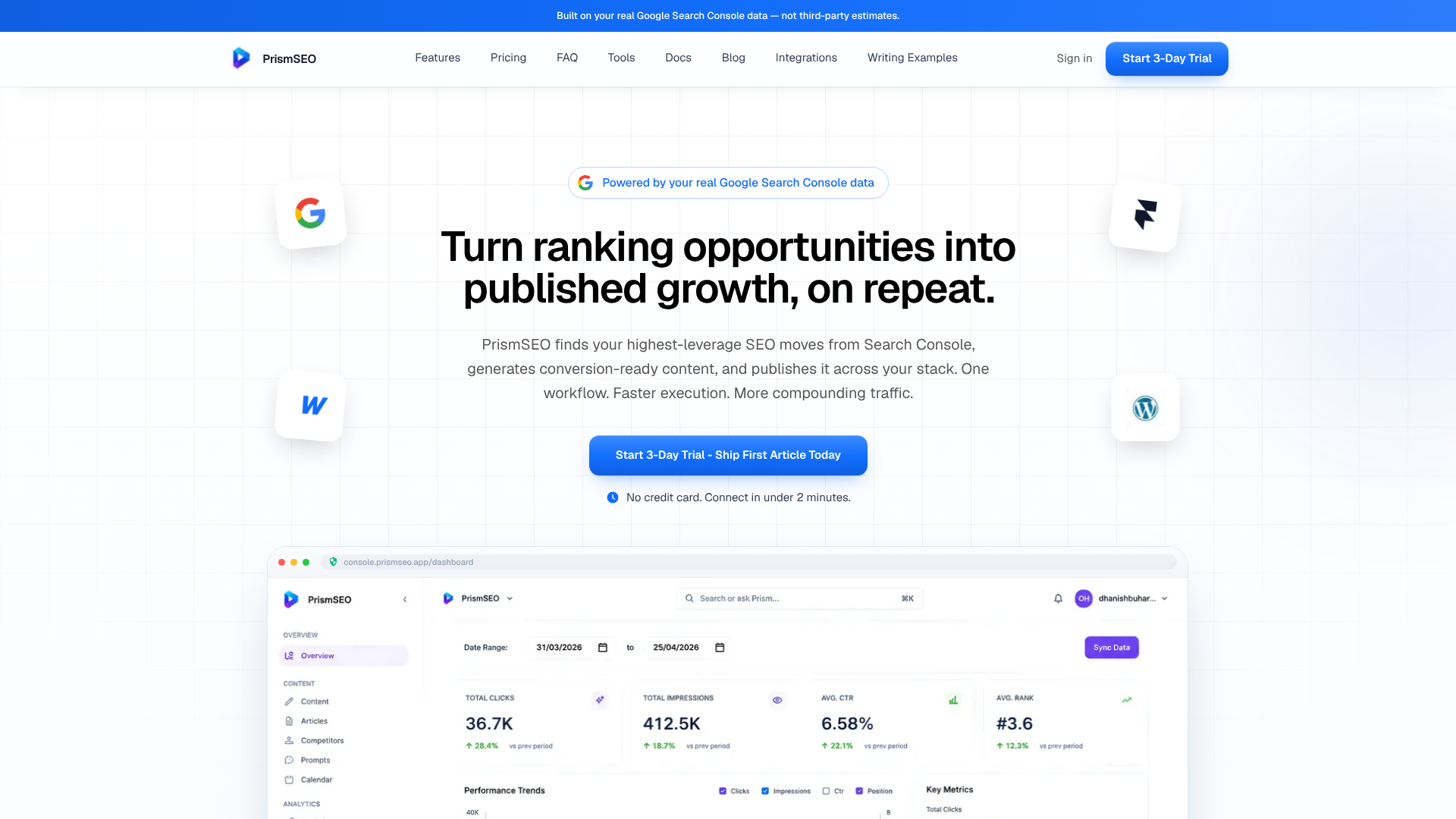
Every strategy discussed matters in enhancing your SEO content efforts. Understanding why SEO content often misses the mark, mastering its mechanics, and utilizing metrics are essential steps. However, these approaches often fall short at the critical point where data needs to be change into actionable content. They provide the tools but not the smooth integration from insight to execution. This is where we built PrismSEO to address a distinctly different challenge. Rather than stopping at data analysis, PrismSEO leverages real Google Search Console data to identify the most impactful SEO opportunities. By automatically generating high-quality, conversion-ready articles and enabling one-click publishing, we close the execution gap. This simplify workflow turns your insights into tangible growth, week after week, allowing your team to ship consistent traffic increases without scaling headcount.
Frequently Asked Questions
Q1: What skills does an SEO content writer need?
An SEO content writer needs skills in keyword research, content optimization, and understanding SEO tools. Strong writing and analytical skills are also essential.
Q2: How do SEO content writers improve rankings?
SEO content writers improve rankings by crafting content that is optimized for target keywords, engaging, and aligned with search intent.
Q3: What is the difference between SEO content writing and copywriting?
SEO content writing focuses on optimizing content for search engines, while copywriting emphasizes persuasive and engaging language to drive conversions.
Q4: How can I become an SEO content writer?
To become an SEO content writer, learn SEO basics, practice writing optimized content, and use tools like Google Analytics to track performance.
This article was researched and drafted with PrismSEO, then reviewed before publishing.