content strategy
How to Integrate SEO and Content Marketing for Real Growth
Learn to integrate SEO with content marketing to boost visibility and engagement. Discover effective strategies for measurable results.
Published: 10/10/2026
How to Integrate SEO and Content Marketing for Real Growth

You've poured time, energy, and budget into both SEO and content marketing, yet your traffic still feels like a stubborn mule. You've mapped out keywords, crafted content around them, and waited. But the needle isn't moving, and you're wondering why your efforts feel more like guesswork than strategy.
Here's the real kicker: Without blending SEO with your content marketing, you're not just spinning your wheels; you're burning through resources and missing growth opportunities that could change your business. Imagine building a beautiful car and never fueling it up. That's your content without SEO driving it. No coordinated strategy means you're fading into the digital ether while competitors speed past.
We show you how to bridge that gap. By the end, you'll know exactly which tools to use, what traps to avoid, and how to align SEO with your content for visibility that actually sticks. We'll break down proven integration tactics from setting up workflows to using tools like PrismSEO that convert insights into action at lightning speed.
Think you've checked all the SEO boxes? Think again. Most get stuck in cycles of endless optimization without tangible growth. The missing link? Strategic integration. Ready to propel your content and SEO into the revenue-driving machine it should be? Let's get that potential.
⚡ Quick Answer
- 🏆 Best overall: Holistic SEO Strategy: combines technical SEO and content planning seamlessly
- 💸 Best budget: Keyword Research Tools: essential for aligning content with search intent
- 🚀 Best for small teams: Content Management Systems: streamline content creation and optimization
Why SEO Alone Isn't Enough
SEO can bring clicks, but clicks alone don't sustain growth. Technical optimizations, like site speed or mobile-friendliness, can only push your rankings so far. Without engaging content, you’re just optimizing for a race car that never leaves the garage. Content gives your SEO depth and engagement, keeping users on your page and getting them to return.
| Factor | What It Measures | Why It Matters | How to Evaluate It | Weight/Priority |
|---|---|---|---|---|
| Content Quality | User engagement | Keeps visitors on the site | Check bounce rate in Google Analytics | High |
| Keyword Relevance | Search intent match | Drives targeted traffic | Run a keyword analysis via SEMrush | Medium |
| Backlinks | Authority and trust | Improves domain authority | Check Ahrefs DR score | High |
| Technical SEO | Site performance | Affects crawlability and speed | Run a crawl in Screaming Frog | Medium |
| Content Frequency | Update cycles | Keeps content fresh | Schedule regular audits | Low |
The Limits of SEO
SEO tactics like keyword research and site structure are crucial, but they don’t tell the whole story. You can't rely solely on technical SEO to move the needle. Google's algorithms favor sites that offer value through quality content. Without content, even the best-optimized site is just an empty shell. You need to deliver substance to rank on the Search Engine Results Page.
Content Is King, Not a Pawn SEO will get you indexed, but content keeps you in the game. A site full of technical optimizations but devoid of substance is like a book with a gripping cover and blank pages inside.
Content's Role in SEO
Content isn’t just filler; it’s the heart of any digital marketing strategy. It’s what turns organic traffic into meaningful engagement. Articles, videos, infographics-each builds value for your audience and authority for your site. When you align your content strategy with your SEO efforts, you create a feedback loop that multiplies value. That's when you see your metrics shift from clicks to conversions.
When SEO Falls Short
Even the most strong SEO tools can't fix poor content. If you're seeing dwindling organic traffic despite strong technical benchmarks, the problem likely lies in your content strategy. In the new search era, the algorithms are increasingly sophisticated, evaluating not just keywords but narrative and engagement.
If SEO is the engine, content is the fuel. Without it, your strategy will stall. Next, let's break down "The Mechanics of SEO and Content Marketing" to see how these elements work together to power your growth.
The Mechanics of SEO and Content Marketing

How SEO Supports Content
Most businesses misunderstand SEO as just a checklist of tactics. SEO is about helping people discover your content. But many skip the nuances. Effective SEO supports your content by aligning it with search intent. Google Analytics isn't just a traffic counter; it reveals what viewers really want.
Understanding search engine optimization metrics like bounce rate and click-through rate means nothing if you don't adjust your content strategy accordingly. A high bounce rate can scream, "This is not what they expected!" Yet, most teams ignore it, missing a chance to refine their content to match audience expectations.
Don't Trust All Metrics Blindly Keyword research tools might flash promising numbers, but they don't tell you if your content fits the query's context. Always verify SERP intent.
Content as an SEO Driver
Content is the engine of your SEO efforts. It's what Google indexes and what users consume. High-quality articles can change digital marketing strategy by attracting backlinks and enhancing authority. Your content should answer the questions your audience isn't even asking yet. That's how you stay ahead.
SEO tools might suggest keywords, but real success comes when content creation turns those keywords into engaging stories. Many think ranking stops at writing; it starts there. The best content doesn't just fill word counts; it fills needs.
Combination Effects
When SEO and content marketing work together, they create a formidable force. SEO metrics guide content adjustments, while well-crafted content can improve SEO performance, leading to more organic traffic. This combination isn't just a happy coincidence; it's a strategy that brings measurable results. A symbiotic relationship, just like the one described here, is what elevates both elements.
Yet, the danger lies in complacency. Never assume content and SEO will magically sync. Poor execution can derail even the best plans. Regular audits ensure everything aligns with your goals.
With the mechanics clear, knowing the key drivers of successful integration becomes the next logical step. Let's dig into what truly fuels a smooth SEO and content strategy.
Key Drivers of Successful Integration
Keyword Research
Think keyword research is just about finding the right phrases? Think again. It's about aligning your content with what your audience actually cares about. Most businesses spend time generating lists using tools like Ahrefs and SEMrush, yet stop short of understanding what truly resonates. They have the data but miss the narrative.
The irony here? The best insights aren't buried in a tool, they're in the questions your customers ask. SEO tools like Ahrefs can give you a keyword difficulty score, sure, but they can’t tell you how to craft content that answers your user's real questions. That’s the gap where your strategy can stumble or soar.
Misleading Metrics Keyword difficulty scores alone don't capture SERP intent. To really understand the space, check the top-ranking pages for organic traffic potential and how they address user needs.
Content Relevance
Irrelevant content is like a Seinfeld episode with no premise-it goes nowhere. To make your content hit home, it must be relevant to both the search engine and the user. This requires more than sprinkling keywords throughout a page; it means ensuring the content matches user intent, which is often overlooked.
Factor in user behavior metrics like bounce rate and dwell time. A piece of content rich in value will keep users engaged, which positively impacts your SEO. Using SEMrush, you can further analyze competitors to see what works and what doesn't. But remember, metrics won't replace genuine understanding.
User Experience
User experience isn't just the icing on the SEO cake; it’s the main ingredient. The smoother your site performs, the more likely users are to stick around, and search engines notice that. Load times, mobile responsiveness, and intuitive design-these factors contribute directly to your digital marketing strategy's success.
If your site feels like a maze from a bad horror film, even the best SEO tactics won’t save you. Prioritize a smooth experience from the moment a visitor lands on your page. User experience affects everything from organic traffic to conversion rates-it's a key driver of your content strategy.
SEO content marketing not only improves search engine rankings but also enhances user experience by delivering relevant, valuable information.
Understanding these key drivers sets the stage for successful integration. Now let's break down exactly how you can implement these concepts in the "Step-by-Step Guide to Integrating SEO and Content Marketing".
Here's the full process:
| Step | Action | Time Required | Common Mistake | Expected Result |
|---|---|---|---|---|
| 1 | Open Ahrefs Site Explorer, enter your domain | 30 min | Ignoring low-volume keywords | Identify high-impact keywords |
| 2 | Analyze competitor pages with SEMrush | 1 hr | Copying instead of innovating | Understand successful content strategies |
| 3 | Draft content focusing on user questions | 2 hrs | Overloading with keywords | Create engaging, relevant content |
| 4 | Check site speed and mobile compatibility | 1 hr | Neglecting mobile users | improve for better user experience |
| 5 | Publish and monitor user engagement metrics | 1 hr | Ignoring post-launch metrics | Adjust strategy based on data |
Step-by-Step Guide to Integrating SEO and Content Marketing

Define Your Goals
Jumping into SEO and content marketing without clear goals is like driving blindfolded. You need a destination before mapping the route. Identify what you want to achieve. Is it more organic traffic, higher rankings, or increased conversions? Each goal requires different strategies, so clarity is key. Setting SMART goals (Specific, Measurable, Achievable, Relevant, Time-bound) simplify your efforts and provides a benchmark for success. Lack of clear objectives leads to scattered efforts, diluting results. Define your goals upfront for a focused approach.
Conduct Keyword Research
Effective keyword research is more than just picking high-volume terms. It's about understanding your audience's intent and finding keywords that align with your goals. Use tools like Google Keyword Planner or SEMrush to identify opportunities. But remember, numbers alone aren't enough. Analyze the SERPs to ensure your content matches the intent behind those keywords. Many fail here, focusing solely on search volume without considering if their content answers the query. Keyword research informs your entire digital marketing strategy, so get it right.
Create and improve Content
Great content isn't just well-written; it's optimized for search engines too. Begin by aligning your content with your goals and chosen keywords. Use an editorial calendar to plan consistent publishing. Incorporate SEO tactics like using headers effectively, optimizing images, and including internal links. An SEO audit can reveal optimization gaps you might overlook. But beware of over-optimization. Stuffing keywords can hurt rather than help. The goal is to improve search visibility while providing value to your readers. Balance is vital.
Don't Ignore the Calendar Using a content calendar helps maintain a consistent posting schedule. It's not just about planning what to write but also when to publish for maximum impact.
Here's the full process:
| Step | Action | Time Required | Common Mistake | Expected Result |
|---|---|---|---|---|
| 1 | Set clear goals using the SMART framework | 1 hr | Setting vague goals | Clear, actionable objectives |
| 2 | Perform keyword research with specific tools | 2-3 hrs | Ignoring user intent | List of relevant keywords |
| 3 | Plan content using an editorial calendar | 1 hr | Overloading calendar | Well-spaced publishing schedule |
| 4 | Write and improve content for SEO | Variable | Keyword stuffing | SEO-friendly, high-quality content |
| 5 | Conduct an SEO audit | 2 hrs | Skipping technical checks | Identified optimization gaps |
Now that you know how to integrate SEO with content marketing, it's time to explore the tools that can enhance your strategy and simplify your workflow.
Tools to Enhance Your Strategy
Without the right arsenal, your SEO content strategy is just spinning wheels. The trick isn't just about owning the tools-it's about using them effectively. But let's clear the clutter: not every tool suits every strategy. It's about matching your needs to the right capabilities.
| Option | Key Difference | Best Use Case | Main Limitation | Price |
|---|---|---|---|---|
| HubSpot | All-in-one marketing suite | Medium to large teams | Overwhelming for small projects | $50/mo |
| WordPress | Customizable CMS | Independent bloggers | Security vulnerabilities | Free - $45/mo |
SEO Tools
SEO tools are the compass in your digital marketing strategy. They point you to where organic traffic can be gained. Semrush and Ahrefs are often top choices, but each has its quirks. Semrush excels in competitive analysis, while Ahrefs shines in backlink audits. Yet, the biggest pitfall isn't the tool-it's the misuse. People often buy the subscriptions and never explore keyword research as thoroughly as they should.
Highlight Your Gaps Semrush's domain gap tool identifies missed keyword opportunities in minutes; ignoring this feature limits your growth.
Before diving into these tools, know what you need them for. A tool's worth is only as high as its usage. Otherwise, it's just another monthly expense.
Content Management Systems
Content isn't just about creating; storing and organizing it effectively is crucial. That's where a Content Management System (CMS) like WordPress steps in. Its flexibility makes it the go-to for many, but be cautious: without proper configuration, vulnerabilities can leave your site exposed. For those with deeper pockets, HubSpot offers a comprehensive suite that integrates CRM and marketing tools, ideal for teams looking to simplify multiple processes.
Analytics Platforms
Tracking performance isn't optional; it's a requirement. Google Analytics can provide insights into your content strategy's success and areas needing improvement. Tools like this allow you to monitor what works and what flops. Continuous tracking and optimization are essential for achieving SEO success, as highlighted in this external source. Knowing your metrics is great, but without action, numbers are just numbers. For a visual breakdown, worth watching is YouTube · mainstreetroi's analysis on the combination between SEO and content marketing.
All of this sets the stage for our next discussion: identifying the common pitfalls in SEO and how you can steer clear of them.
Video: SEO vs. Content Marketing: What's the Difference and How Do ... (YouTube · mainstreetroi)
Common Pitfalls and How to Avoid Them
Ignoring Data
Skipping data analysis is a shortcut to failure. Many assume they can rely on gut feelings for SEO tactics, but intuition is not strategy. Without leveraging hard data from tools like Google Analytics or SEMrush, you're essentially blindfolded in the digital marketing strategy arena. The result? Wasted effort and poor results. You need data-driven decisions to guide effective content strategy.
Simply put, prioritize data. Ignoring it is as risky as ignoring a map while driving. Yet, a Google Penalty awaits those who misjudge the metrics. Keyword research must inform every piece of content creation, and ignoring search trends is asking for high bounce rates.
Data Isn't Optional Capture data consistently. Use tools to analyze before making your next move. Otherwise, you might as well be shooting arrows in the dark.
Over-Optimizing Content
More keywords don't equal better ranking. Stuffing a web page with keywords can trigger a Google Penalty. Over-optimization, such as excessive keyword density or awkward internal linking, can be detrimental. Instead, balance is key. Google favors content that reads naturally and fulfills a user's query efficiently.
A well-optimized page satisfies both search engines and human visitors. Over-optimized content can hurt your SEO tactics more than help. Avoid turning your content into a keyword soup and focus instead on delivering real value.
Neglecting User Intent
Many creators miss the mark by ignoring user intent. High bounce rates often signal content misalignment with search queries. User intent is the compass guiding effective SEO. It's not just about driving organic traffic but ensuring that traffic stays and converts.
Understanding user intent means analyzing what's ranking and why. Are users looking for information, or are they ready to purchase? Answering this impacts your entire content strategy. Neglecting it is like throwing darts blindfolded.
And once you've sidestepped these pitfalls, you'll need to know if your new approach is paying off. Here's where "Measuring Success: Metrics That Matter" steps in to shape your next move.
Measuring Success: Metrics That Matter
Most teams focus on clicks but miss the real game: engagement and conversion. Without these, traffic's just noise. Use this framework:
| Factor | What It Measures | Why It Matters | How to Evaluate It | Weight/Priority |
|---|---|---|---|---|
| Organic Traffic | Site visits from search engines | Indicates visibility and reach | Use Google Analytics | High |
| Engagement Rate | User interaction like time on page | Reflects content effectiveness | Check bounce rate | Medium |
| Click-Through Rate (CTR) | Percentage of clicks on links | Measures content attractiveness | Analyze Search Console | High |
| Conversion Rate | Percentage of visitors that take action | Shows ROI of SEO efforts | Track using a funnel analysis tool | High |
| Keyword Ranking | Position on search results | Directly affects traffic | Check Ahrefs or SEMrush | Medium |
Traffic and Engagement
Click-Through Rate (CTR) tells you how compelling your page titles and meta descriptions are. High CTRs without engagement mean users find the bait but not the catch. Use tools like Google Analytics to dig into how long users stay and interact. Short visits? You’ve got a content issue, not a traffic one.
Engagement Is King Traffic is vanity; engagement is sanity. If users don’t stick around, tweak your content, not your CTR strategy.
Conversion Rates
Your content strategy should drive users to the end of your conversion funnel. Conversion rates measure ROI. A good SEO tactic turns organic traffic into loyal customers. Use funnel analysis tools to understand leaks. If visitors drop off after landing, question your calls to action, not your keywords.
SEO Performance
Search engine optimization isn't just about getting people on your page. It's about keeping them moving through your content creation process. High keyword ranks mean nothing if they don't align with user intent and lead to conversions. Use SEO tools like Ahrefs to match keyword research with actual user needs.
Metrics don't lie. But they don't tell the whole truth either. As you measure what's happening, it's time to make it actionable. Next, let's break it down into a 30-day plan to integrate these insights effectively.
A 30-Day Plan for Integration
A month might sound short, but with a structured approach, you can embed SEO tactics smooth into your content strategy. Here's the full process:
| Step | Action | Time Required | Common Mistake | Expected Result |
|---|---|---|---|---|
| 1 | Define clear SEO and content goals | 2-3 hrs | Being too vague | Specific, measurable objectives |
| 2 | Conduct keyword research using SEO tools | 1-2 hrs | Ignoring search intent | List of target keywords |
| 3 | Map keywords to content topics | 2 hrs | Overloading content with keywords | Optimized content topics |
| 4 | Create a content calendar | 1 hr | Inconsistent posting schedule | Consistent content rollout |
| 5 | Publish and promote content | Ongoing | Neglecting promotion | Increased organic traffic |
Week 1: Planning
Start with establishing your goals. Most people jump straight to content creation, but without a clear target, you're shooting in the dark. Define specific, measurable objectives that guide your digital marketing strategy. Next, tackle keyword research. Use SEO tools to uncover phrases with high relevance and manageable competition. Match these keywords to your content strategy, ensuring each piece serves a clear purpose.
Don't overload keywords Trying to cram too many keywords into one piece dilutes focus and confuses search engines.
Week 2: Execution
With your roadmap laid out, it's time to create. Focus on content creation with quality over quantity in mind. Each piece should reflect a deep understanding of the keyword and audience intent. Publish according to the schedule you set in your content calendar. Remember, consistency is key; it's better to post less frequently with higher quality than to spam your audience with fluff.
Week 3-4: Optimization
Once your content is live, the work isn't over. Regular optimization enhances results. Analyze performance metrics to identify areas that need tweaking. Update your tactics based on what's working and what isn't. Don't assume early success means a strategy should remain static-search algorithms and audience preferences can shift unexpectedly.
Success in these three phases leads naturally into spotting when adjustments are needed. This tees up a crucial discussion in the next section: knowing when to pivot your strategy to sustain growth in "When to Pivot: Signs Your Strategy Needs Adjustment."
When to Pivot: Signs Your Strategy Needs Adjustment
Declining Traffic
Flat or dropping traffic numbers aren't just a blip; they're a signal. Search engine optimization thrives on momentum, and if your traffic graph looks like a ski slope, it's time to dig deeper. Use Google Search Console to pinpoint where the bleeding starts. Is it a specific page or keyword? Once you know, act. Maybe your content strategy ignored recent algorithm changes, or your SEO tactics lost relevance. Either way, don't sit on it. Action beats analysis paralysis every time.
Snooze on Trends, Lose on Traffic Ignoring SERP changes means losing out. Tools like Google Trends can help you stay ahead by highlighting shifts in search behavior.
Stagnant Conversion Rates
Traffic is great, but without conversions, it's just vanity. If your conversion rates have plateaued, the issue might not be the traffic, but what happens after users arrive. Examine your digital marketing strategy. Are you aligning your content creation with your audience's intent? A/B testing isn't optional. It reveals what resonates and what falls flat. While SEO tools help bring visitors, your page's clarity seals the deal.
Conversion stagnation isn't about flashy redesigns. It's about making minor yet impactful tweaks that align with user expectations, so focus on practical tips over aesthetics.
Feedback and Insights
Your users are your free consultants. If you're not leveraging their feedback, you're flying blind. User Feedback can illuminate why your SEO strategy might be faltering. Is your content missing the mark, or are there technical issues? Incorporate these insights into your keyword research and content revisions. Listen, learn, and adjust. Your next breakthrough might just be buried in a comment.
But remember, feedback isn't gospel. Balance user input with strategic direction-it's your brand at stake.
Feedback Is Gold Surveys and polls can uncover blind spots in your approach. Don't wait for complaints to pile up-proactive outreach turns insights into actionable data.
Pivots aren't failures; they're course corrections. Stubbornly sticking to a flawed plan only guarantees mediocrity. Adapt, adjust, and let data guide your way forward. The only failure is in doing nothing at all.
The Missing Link in SEO Content Integration
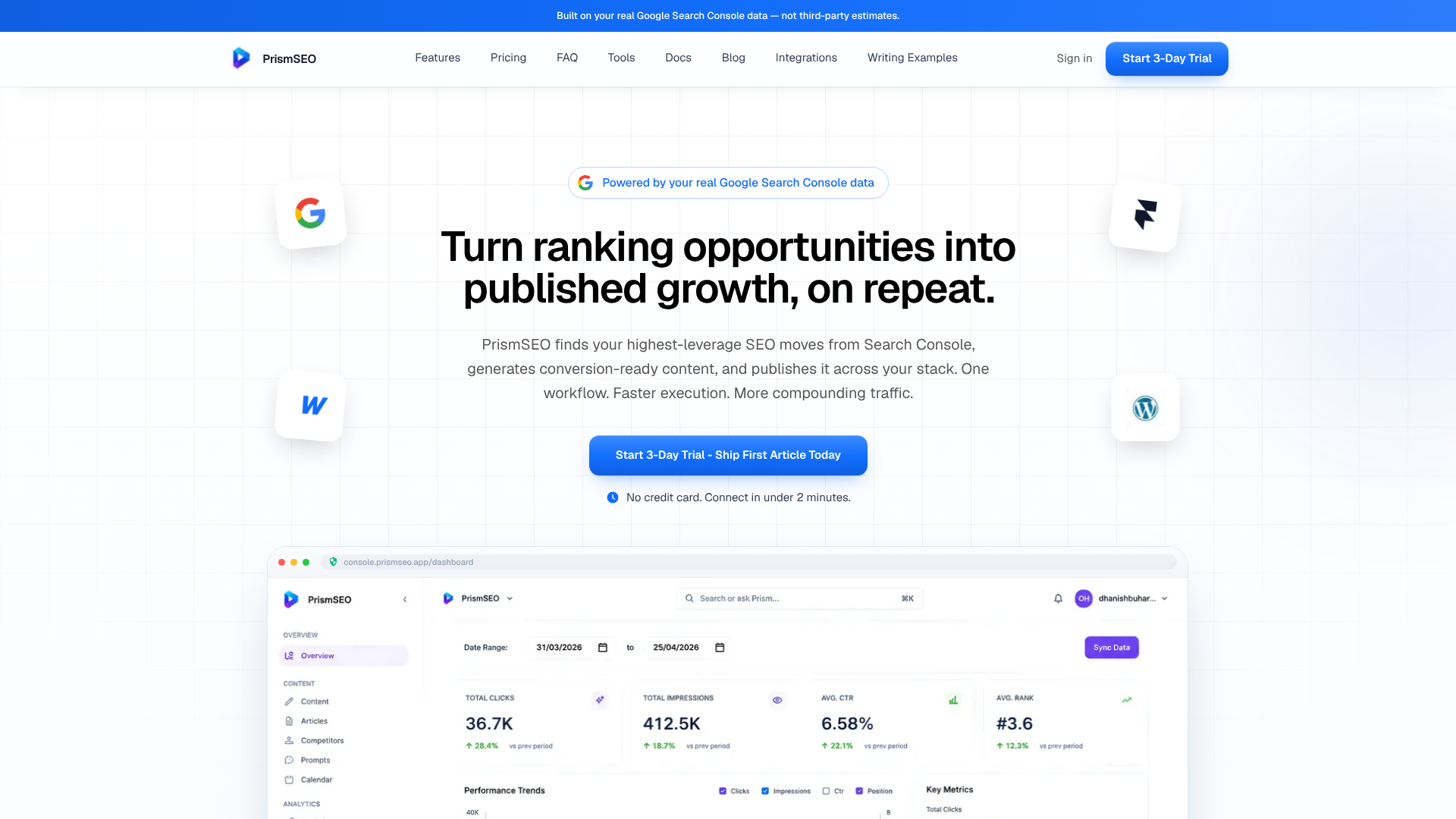
SEO strategies, especially when integrated with content marketing, have the power to drive substantial traffic. Our guide walked you through optimizing mechanics and enhancing strategies with top-notch tools. It even offered a 30-day action plan to align your goals. However, these approaches often fall short at the critical execution stage-change rich keyword data into actionable, published content without delays. This is where PrismSEO enters the scene. It doesn't just provide insights; it turns your Google Search Console data into prioritized SEO opportunities and crafts high-quality articles, ready for direct publishing. By streamlining the entire process, from signal to published page, PrismSEO help high-velocity teams to translate search data into consistent traffic growth, leaving other methods at the starting line. With its AI-driven insights and one-click workflows, you're not just discovering opportunities-you're acting on them, week after week.
Frequently Asked Questions
Q1: How does SEO complement content marketing?
SEO enhances content visibility by optimizing it for search engines, ensuring it reaches a wider audience.
Q2: What are the benefits of integrating SEO with content marketing?
Integration boosts organic traffic, improves user engagement, and increases conversion rates.
Q3: How can I measure the success of my SEO and content marketing efforts?
Track metrics like organic traffic, engagement rates, and conversion rates to gauge success.
Q4: What tools can help integrate SEO and content marketing?
Tools like Ahrefs, SEMrush, and HubSpot simplify integration by providing insights and optimization capabilities.
This article was researched and drafted with PrismSEO, then reviewed before publishing.